

KoreanDerm

When Mara Jensen, 43, looked at her bathroom shelf last spring, she counted nine products. Serum. Retinol. Peptide moisturizer. Eye cream. Face oil. Sleeping pack on top. Every one of them “dermatologist-recommended.” Every one of them expensive.
She’d been building this routine for almost a decade. And yet she couldn’t shake the feeling that something wasn’t working. Not dramatically. But quietly — the way a car engine slowly loses power before you realize there’s something wrong under the hood.
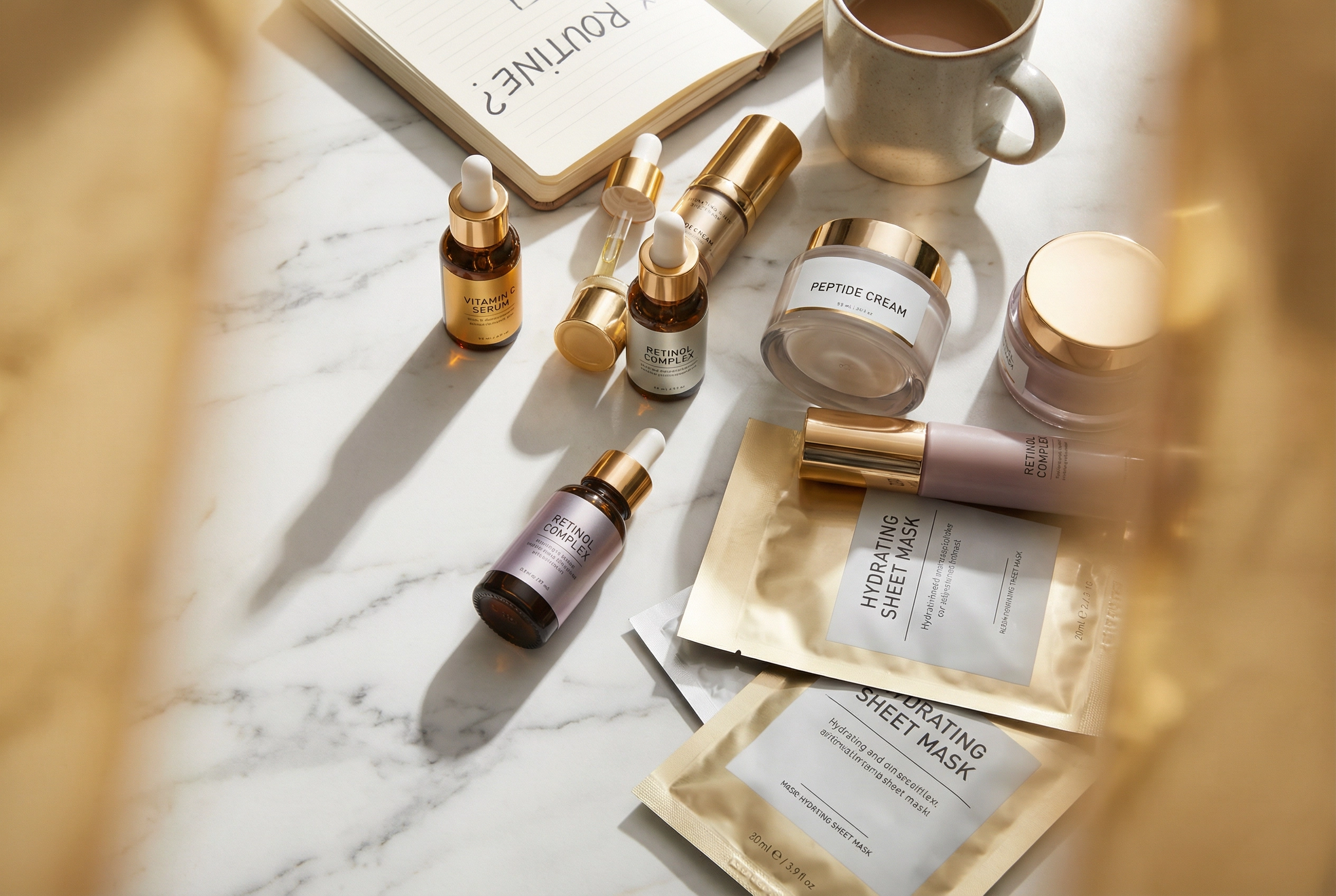
Nine products. A decade of routine. And a growing suspicion that none of it was working.
Her face didn’t look bad. It just didn’t look like her. The freshness she remembered from her mid-thirties had been replaced by something duller. Slightly more tired. Slightly more aged, in a way that no amount of extra sleep seemed to fix.
She wasn’t alone. According to a 2024 analysis, nearly 71% of women over 35 who maintain consistent skincare routines still report feeling dissatisfied with their results — despite spending an average of $247 per month on products.
“The problem wasn’t the products. The problem was a biological wall I didn’t know existed.”
What Mara eventually discovered — buried in a research paper out of Seoul National University — has dermatologists in the U.S. paying close attention. And it explains why the majority of the anti-aging skincare industry may be fundamentally, structurally flawed.
“I Was Doing Everything Right. So Why Did I Feel Like I Was Getting Worse?”
Mara grew up watching her mother age gracefully. No Botox. No procedures. Just discipline — a consistent morning routine, good sleep, no alcohol. That was Mara’s template.
She started taking skincare seriously at 31. A gentle cleanser. SPF every day. A basic moisturizer. It was simple and her skin responded well. But by 34, she started noticing the first changes — a shallowing of the glow she’d taken for granted. Fine texture around her mouth. A dullness that made her feel, in her own words, “like a slightly faded version of myself.”
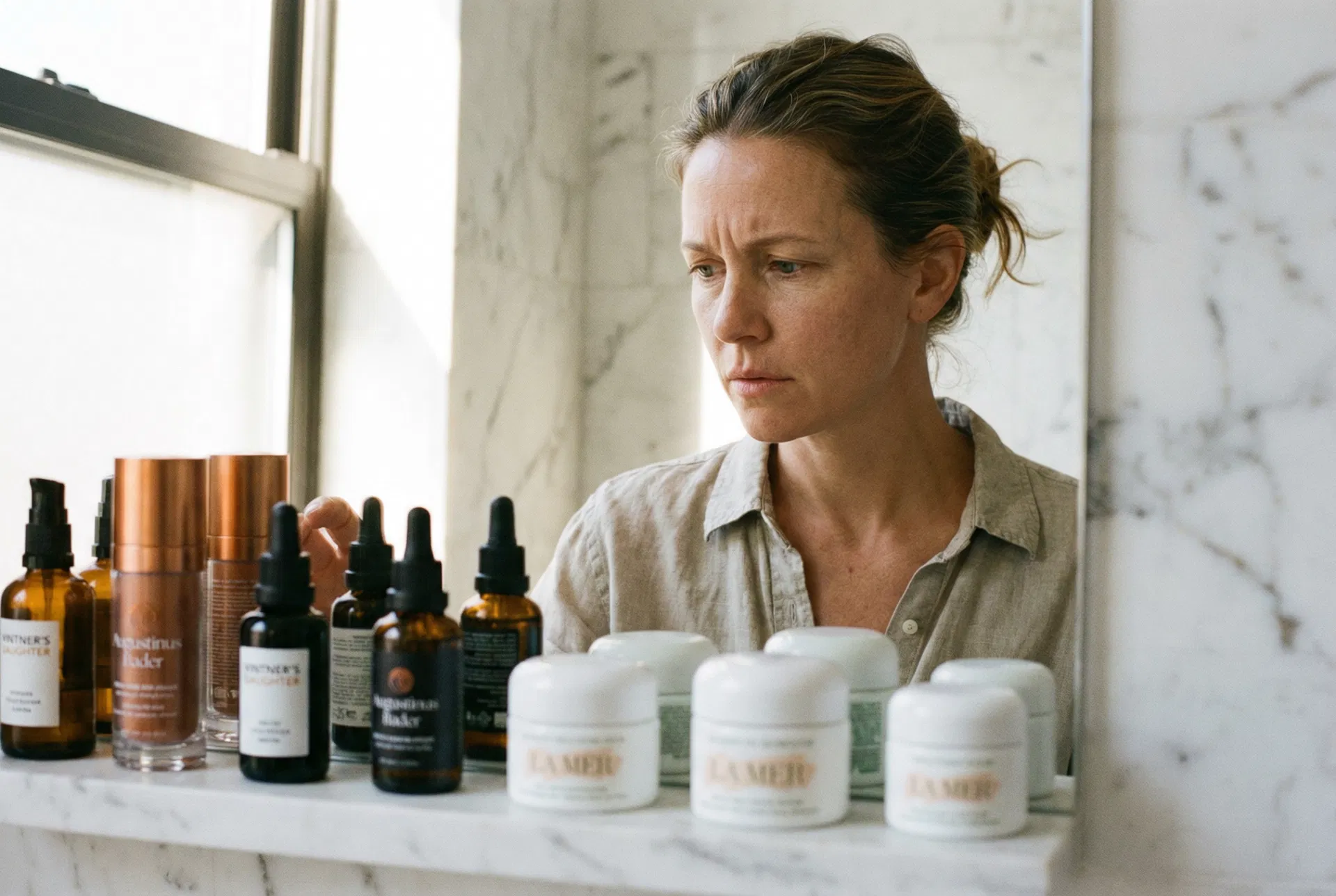
Mara Jensen, 43, at home. “I was doing everything the experts said. I just couldn’t see it working.”
So she did what any intelligent woman does: she researched. She upgraded. She spent three evenings going down skincare forums and came out the other side with a new routine and $340 worth of new products.
The vitamin C serum lasted four months before she noticed it was oxidizing. The retinol worked but destroyed her barrier for six weeks — red, peeling, reactive skin that made her look older, not younger, until things settled. The peptide moisturizer was smooth and expensive and did nothing she could actually see.
“Every product I tried came with a reason it hadn’t worked. I was always one product away from the result I wanted.”
By 40, Mara’s routine had expanded to nine steps. Her bathroom shelf looked like a pharmacy. And while she wasn’t visibly aging badly, she was stuck. No forward movement. No real improvement. Just maintenance — of a face she was quietly disappointed by.

The family dinner in January 2024. “You look exhausted,” her sister said. Mara had slept eight hours.
The breaking point came at a family dinner in January 2024. Her younger sister, visiting from Portland, looked at her across the table and said: “You look exhausted. Are you sleeping okay?”
Mara had slept eight hours the night before. She’d done her full routine. She wasn’t exhausted. She was invisible in the one way that felt hardest to explain: her face had stopped communicating vitality.
That night, she didn’t go back to her routine. Instead, she started a different kind of search. Not for another product. For an explanation.
The “Skin Barrier” Everyone Talks About — And the Second Barrier Nobody Does
Most women in the skincare space know about the skin barrier — the protective outer layer that keeps moisture in and irritants out. It’s why you’re not supposed to over-exfoliate. It’s why retinol causes purging.
But there’s a second barrier that almost no mainstream skincare brand talks about. And it’s the reason that Mara — and millions of women like her — were spending hundreds of dollars on products that were, at a biological level, bouncing off the surface of their skin.
Collagen lives in the dermis — the deep layer of the skin. But most topical collagen molecules are far too large to penetrate the epidermis, which is the barrier layer above it. They sit on the surface. They create a temporary feeling of plumpness from surface hydration. But they never reach the cells that produce and maintain actual collagen. Women feel like their product is working because their skin feels temporarily softer. But structurally, nothing has changed.
— Dr. Sun-Yi Park, Cosmetic Dermatologist, New York
Former researcher, Korean Institute of Dermatological Sciences
The technical measurement is called molecular weight, expressed in units called Daltons. To cross the epidermal barrier and reach the dermal layer where collagen is actually produced, maintained, and replenished, a molecule needs to be under approximately 500 Daltons in size.
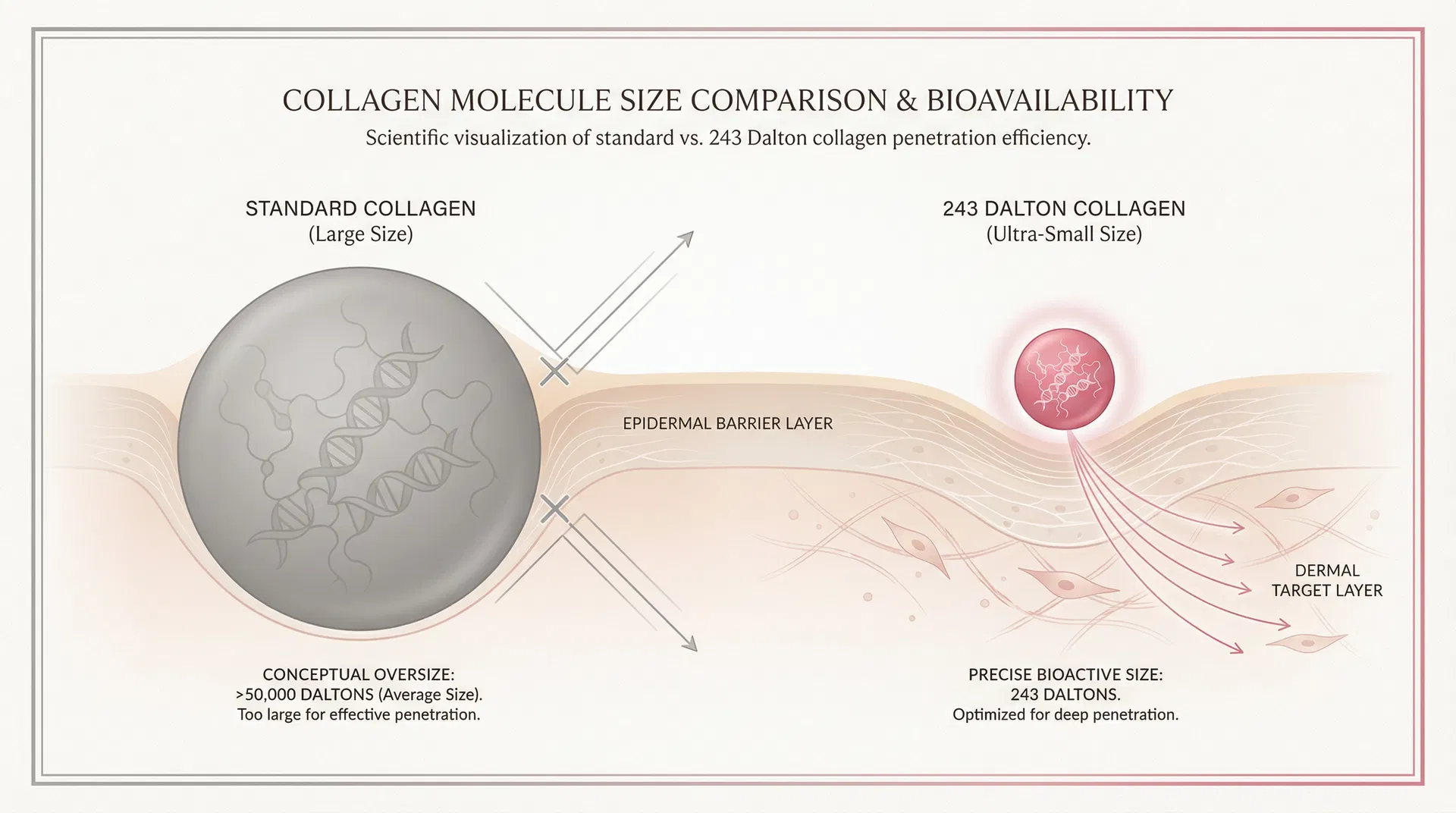
Standard collagen molecules are too large to penetrate the epidermal barrier. 243-Dalton collagen passes through to the dermis.
Standard collagen in most creams, serums, and masks? It measures between 300,000 and 3,000,000 Daltons. That’s not a rounding error. That’s up to six thousand times too large to penetrate.
This isn’t a secret in dermatology. It’s well-documented in peer-reviewed literature. But it’s economically inconvenient for an industry built on selling you collagen products that feel good on the surface.
“You haven’t been failing at skincare. Your skincare has been failing physics.”
And the damage compounds. After 30, your body’s collagen production declines by approximately 1% per year. Stress, poor sleep, UV exposure, and cortisol accelerate that rate. If topical replenishment isn’t actually reaching the dermis, you’re simply losing ground every year with no real way to stop it — no matter how sophisticated your routine is.
The molecular weight needed to actually penetrate the skin barrier and reach the dermis. Standard collagen is 300,000+ Daltons — over 1,200x too large.
The Size Breakthrough: When Korean Biochemists Decided to Solve the Problem From the Inside
The Korean cosmetic science community has been aware of this molecular weight problem for over fifteen years. While the Western beauty industry was focused on marketing collagen’s benefits, Korean biochemists were obsessed with a different question:
What if you made the collagen molecule small enough to actually get through?

Inside a Korean cosmetic biochemistry lab: engineering collagen molecules small enough to cross the epidermal barrier.
The process is called Low Molecular Weight Hydrolysis — essentially, breaking collagen protein chains down into peptide fragments small enough to pass through the epidermal barrier and interact with dermal cells. After years of refinement, researchers achieved what’s now known as Low Molecular Collagen — compressed to approximately 243 Daltons. Not 300,000. Two hundred and forty-three.
At that size, collagen peptides don’t sit on the surface of skin. They cross it. They reach the fibroblast cells in the dermis — the cells responsible for producing your own collagen — and signal them to increase production. Instead of temporarily masking lost collagen from the outside, the mechanism triggers the skin to rebuild from within.
Low molecular collagen represents a genuine paradigm shift in topical delivery. The molecules are small enough to function like signaling peptides. They don’t replace collagen — they tell your skin to make more of it. That distinction is significant.
— Dr. Sun-Yi Park, Cosmetic Dermatologist
But delivery method matters as much as molecule size. A cream dilutes these peptides in emulsifiers and water. Contact time is limited — minutes before the product is absorbed or transferred. The real innovation came when Korean formulation labs realized that the mechanism only reaches its full potential through sustained, direct-contact delivery — meaning the collagen needs to be in uninterrupted contact with the skin for hours, not minutes.
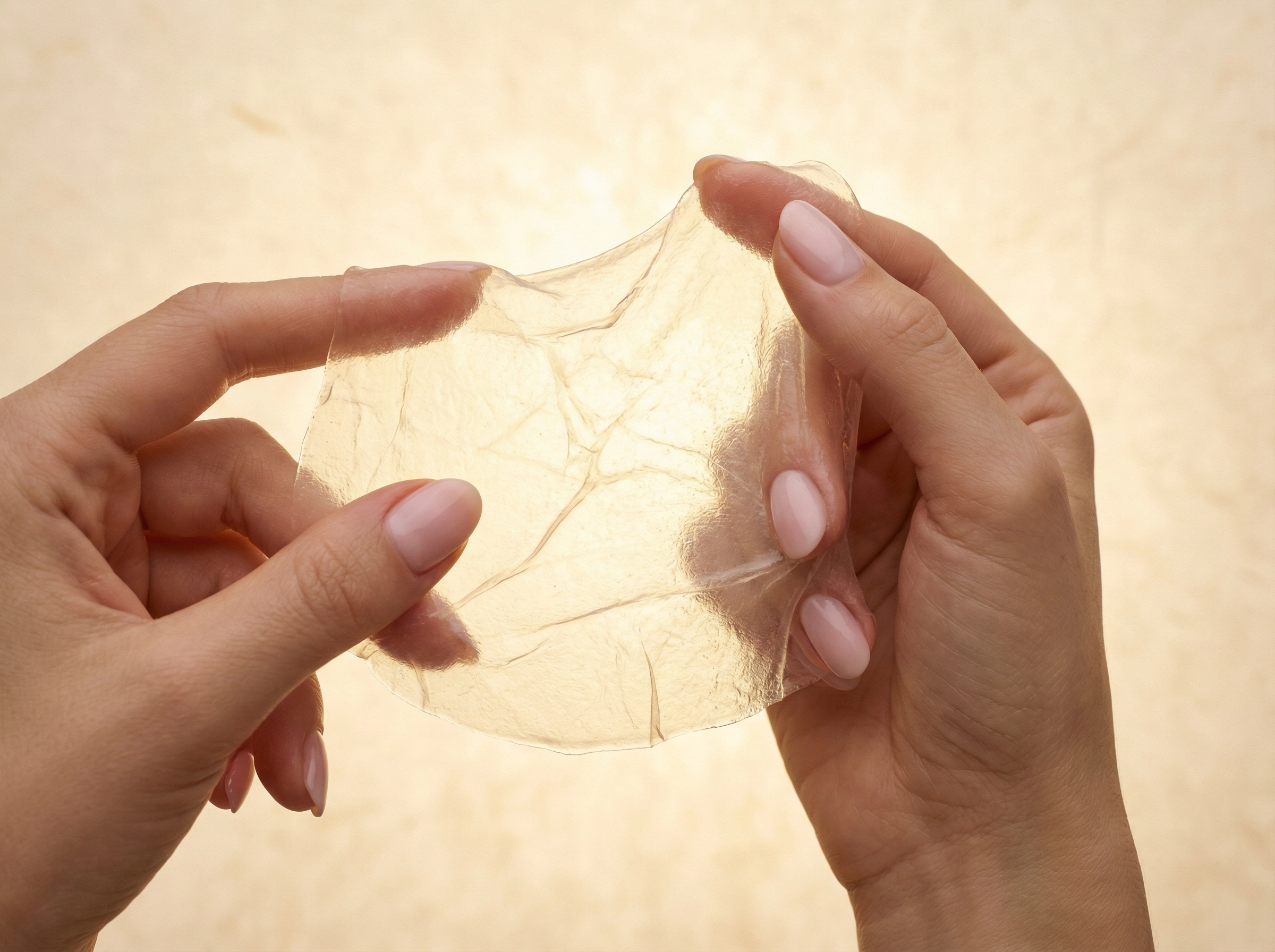
The dissolving collagen film: a thin membrane of concentrated 243-Dalton collagen that adheres to the skin and slowly dissolves as the ingredients are absorbed.
The solution was a dissolving collagen film rather than a cream or serum. A thin membrane of concentrated low molecular collagen that adheres to the skin, eliminates the dilution problem, and slowly dissolves as the ingredients are absorbed. The visual proof: the white film turns translucent as it’s drawn in. By morning, if it’s working, it’s gone.
“The mask either disappears overnight, or it doesn’t. There’s no hiding whether it absorbed.”
“Why Wasn’t Anyone Selling This in the U.S.?”
When Mara found her way to this research in early 2024, her first reaction wasn’t excitement. It was frustration.
“If this science exists, why isn’t every skincare brand doing this? Why am I reading about 243-Dalton collagen in an academic paper and not on the back of a $40 serum?”
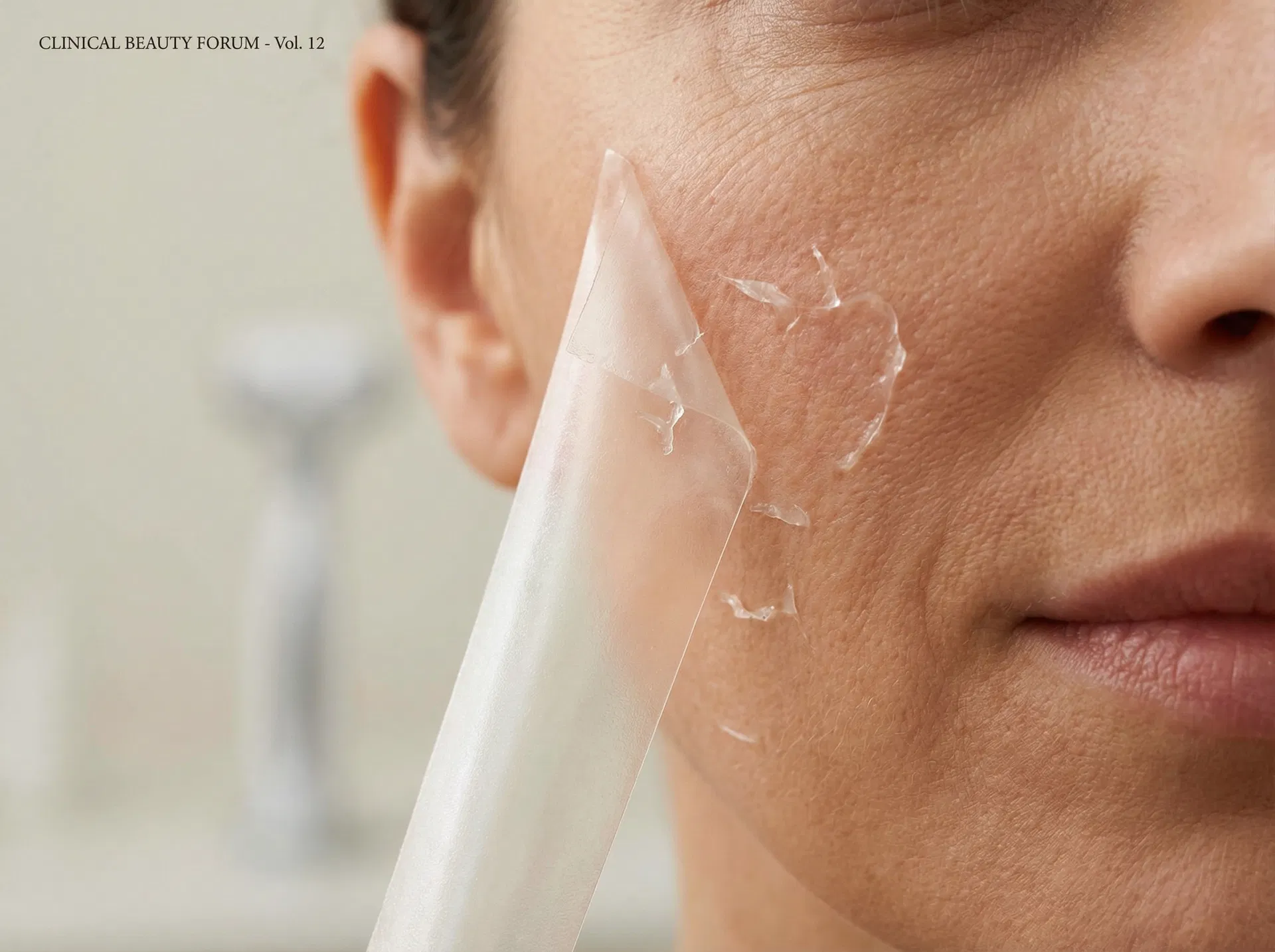
The dissolving collagen film in action. The white membrane slowly turns translucent as 243-Dalton collagen is absorbed through the epidermis.
The answer, as it often is, was commercial. The process of hydrolyzing collagen to ultra-low molecular weight while preserving its bioactive properties is technically demanding, expensive, and difficult to standardize at scale. Most of the products using any version of this technology were coming out of specialized Korean labs — and the handful of brands in the West doing it at all were doing it at concentrations too low to matter.
WellNature, a small beauty company founded by a team with sourcing connections to Korean cosmetic laboratories, was the first U.S.-based brand to bring the full-strength formulation to market — not as a premium prestige product with a $200 price tag, but as a $7-per-treatment overnight mask available directly to consumers.
Getting the formulation right took eighteen months of sourcing, testing, and refining. The challenge wasn’t just the collagen molecule itself — it was the film delivery system. The membrane had to be thin enough to feel comfortable overnight, hydrophilic enough to draw the collagen through as it dissolved, and stable enough to preserve potency on a shelf.
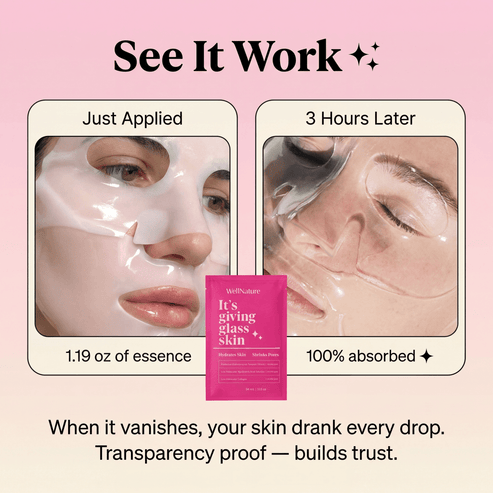
Transparency proof: the mask starts white and turns translucent as collagen is absorbed. Visible confirmation the product is penetrating.
The result was paired with two additional compounds: Galactomyces Ferment Filtrate, the fermented yeast extract behind Korean “glass skin” that brightens and evens tone, and a Hyaluronic Acid Complex that binds water into the dermis for structural hydration that lasts through the following day.
WellNature’s first three production runs sold out before the company could restock. They’ve now sold out five times.
The Product: WellNature Deep Collagen Overnight Mask
The product Mara eventually tried — and the one that has since generated what the brand describes as a surge of repeat customers — is called the WellNature Deep Collagen Overnight Mask.
It is not a sheet mask. It is not a sleeping pack. It’s a dissolving collagen film — a single-use membrane of concentrated 243-Dalton Low Molecular Collagen, Galactomyces Ferment Filtrate, and Hyaluronic Complex, engineered to be worn for a minimum of four hours and preferably overnight.
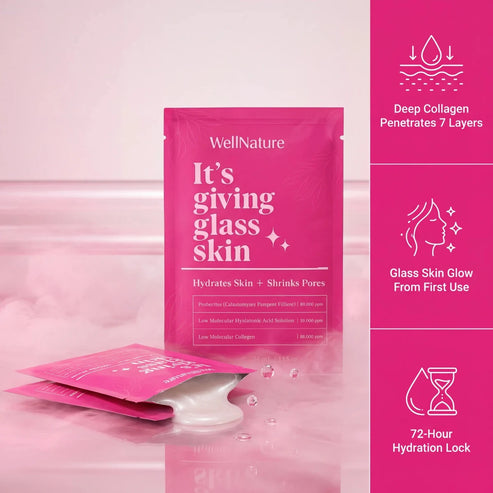
WellNature Deep Collagen Overnight Mask
243-Dalton Low Molecular Collagen + Galactomyces Ferment Filtrate + Hyaluronic Complex. 10 dissolving film masks per box. Apply after cleansing. Sleep in it. Wake up different.
Application takes ninety seconds. You unfold the film, press it flat against clean skin, and go to sleep. That’s the entire routine. No layering. No waiting for absorption between steps. No guessing whether anything is working.

Apply it. Sleep in it. Let your skin do the rest. By morning, the film has dissolved — not into the pillow, into the skin.
In the morning, the film has dissolved. Not into the pillow — into the skin. The translucency shift as it absorbs is visible in real time. It’s the most immediate, tangible proof-of-penetration of any skincare format on the market.
What you’re getting: 10 masks per box. At the recommended frequency of 3–4 times per week, one box lasts approximately three weeks. At current pricing, each treatment costs $7 — less than a single use of most premium night creams, with a delivery mechanism those creams physiologically cannot replicate.
What Mara Saw — And What Other Women Are Reporting
Mara used her first mask on a Thursday night. Friday morning, she described her skin as “almost disconcertingly plump” — the kind of texture she associated with mornings after long sleep, but more consistent. Over four weeks of use at four nights per week, the changes became structural. The fine texture around her mouth softened. The dullness that had been her baseline for three years started to lift.

Day nineteen. Her husband noticed. By week five, her sister called to ask what she’d changed.
Her husband noticed on day nineteen. Her sister, the same one who’d asked if she was sleeping okay, called in week five to ask what she’d changed. When Mara told her, the sister ordered a box the same evening.
She wasn’t alone in the experience. Since WellNature opened reviews on their site, the pattern across thousands of verified purchases has been consistent:
“I’ve been doing skincare seriously for eight years. This is the first product I’ve used where I felt an actual structural difference — not just surface smoothness. My skin looks the way it did when I was 36. I can’t explain it other than something is clearly getting in.”
“Watching it dissolve is genuinely surreal the first time. By morning it’s completely gone. Not into the pillow — into my face. I wake up and my skin looks like I slept ten hours even when I didn’t.”

“For the first time in years I actually recognize it when I look in the mirror in the morning.”
“My dermatologist asked what I’d changed. When I told her about the 243 Dalton formulation she paused and said ‘okay, that actually makes sense.’ That was the validation I needed.”
“I’m someone who reads ingredient lists and molecular weights before I buy anything. This is the real thing. I’ve tried three other collagen masks. None of them dissolved. This one disappears by morning every single time.”
Since this article was originally published, WellNature has sold out of their current batch and is now shipping from limited reserve inventory. Pricing and bundle discounts are still active online, but availability may change. Tap here to check current stock →
“I still have seven products on my bathroom shelf. But I’ve stopped adding to it. What changed isn’t my routine — it’s my face. For the first time in years I actually recognize it when I look in the mirror in the morning. That’s all I ever wanted.”
— Mara Jensen, 43
Limited inventory · Ships within 24 hours · Free returns on first order