I've Been a Dermatologist for 14 Years. I've Never Recommended a Skincare Mask. Until Now. — DermInsider
Skin Wellness · Expert Perspectives
I've Been a Dermatologist for 14 Years. I've Never Recommended a Skincare Mask. Until Now.
Why I spent over a decade telling my patients to skip the masks — and the Korean formulation that made me change my position entirely.
★★★★★4,200+ verified reviews5x Sold Out
DermInsider
Skin Wellness · Expert Perspectives · Advertorial · March 2025
DV
By Dr. Diane Vasquez, MD, FAAD · Board-Certified Dermatologist, New York
Posted: 22 minutes ago
I want to be upfront about something before you read this.
I am not the kind of dermatologist who recommends skincare products. I never have been. In fourteen years of practice, I have watched my patients spend enormous amounts of money on serums, creams, and masks that I knew — from basic biochemistry — could not do what the packaging claimed. I stayed quiet about it because recommending expensive lifestyle products isn't my job.
My approach has always been simple: be honest, look at the evidence, and only recommend what actually works.
Dr. Vasquez during a skin wellness consultation. "I've always believed in honesty over hype."
So when I tell you that I recently broke my own rule — that I am now, for the first time in my career, actively recommending a specific product to a subset of my patients — I want you to understand what that means coming from me.
It means the science finally caught up to the claim.
"I've spent fourteen years watching the anti-aging industry overpromise. This is the first time I've seen a topical product do what it actually says it does."
— Dr. Diane Vasquez, MD, FAAD
Background
Why I Stopped Recommending Skincare Products in 2011 — And What I Watched Happen to My Patients
When I completed my residency, I genuinely believed the skincare industry was more rigorous than it turned out to be. The ingredient science looked compelling. The clinical trials, such as they were, pointed in the right direction. I started recommending the usual suspects to my patients: retinoids, peptide moisturizers, collagen creams.
Within three years, I had stopped recommending most of them.
The beautiful routines that weren't delivering. "The pattern was consistent and frustrating."
Not because they caused harm. Because they caused something worse in some ways: false hope with no result, followed by escalating spending and barrier damage from patients who assumed that if the first thing didn't work, the next step up would.
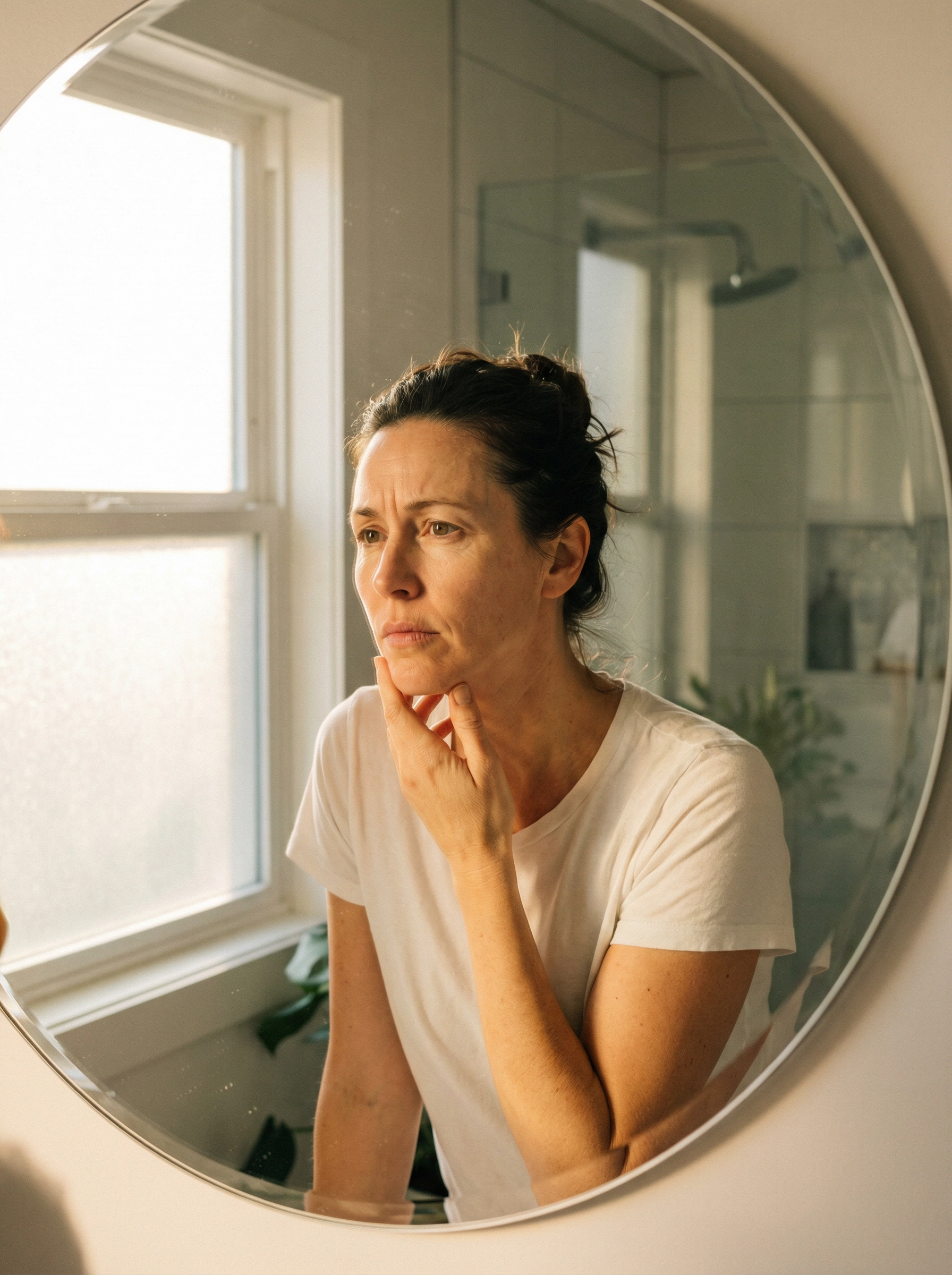
I began keeping informal notes. What patients were spending, what they were using, what they reported back. The pattern was consistent and depressing. Women in their late thirties and forties — educated, thoughtful, research-oriented — building elaborate multi-step routines that were delivering almost nothing structural. Surface hydration, yes. Temporary plumpness from glycerin and hyaluronic acid, yes. But the underlying collagen loss continued. The fine lines deepened. The dullness became a baseline.
"I feel like I'm doing everything right and getting worse. I spend more on my skin than I spend on anything else. I'm at a loss."
— Patient, 41, executive — verbatim from clinical notes, 2019
The expensive routine that wasn't working. Nine products. A decade of spending. No structural improvement.
I heard variations of that sentence hundreds of times. And my honest answer, every time, was that I understood why she felt that way. Because she probably was doing everything right — given what was available to her. She just didn't know, and neither did most of the brands selling to her, that the fundamental delivery problem hadn't been solved.
The molecules weren't getting in.
I knew this. I had known this for years. But there was nothing I could point patients toward instead. So I would send them home with a simplified routine, a gentle cleanser, a non-comedogenic moisturizer, SPF, and the honest advice that the rest was largely theater.
That was my position for over a decade.
The research from Seoul that changed everything. Late 2023.
Then, in late 2023, a colleague forwarded me a research brief out of Seoul that changed how I thought about topical collagen delivery entirely.
The Science
The Dermatology Problem Nobody in the Beauty Industry Wants to Explain to You
Here's what most skincare brands won't tell you about collagen — explained simply.
Collagen is a structural protein. In skin, it lives primarily in the dermis — the deep layer, below the epidermis. It's what gives skin its firmness, bounce, and tensile strength. After age 25, your body's natural collagen production declines at roughly 1% per year. Stress, UV exposure, and elevated cortisol accelerate that rate significantly. This is the biological driver of most of what we call aging.
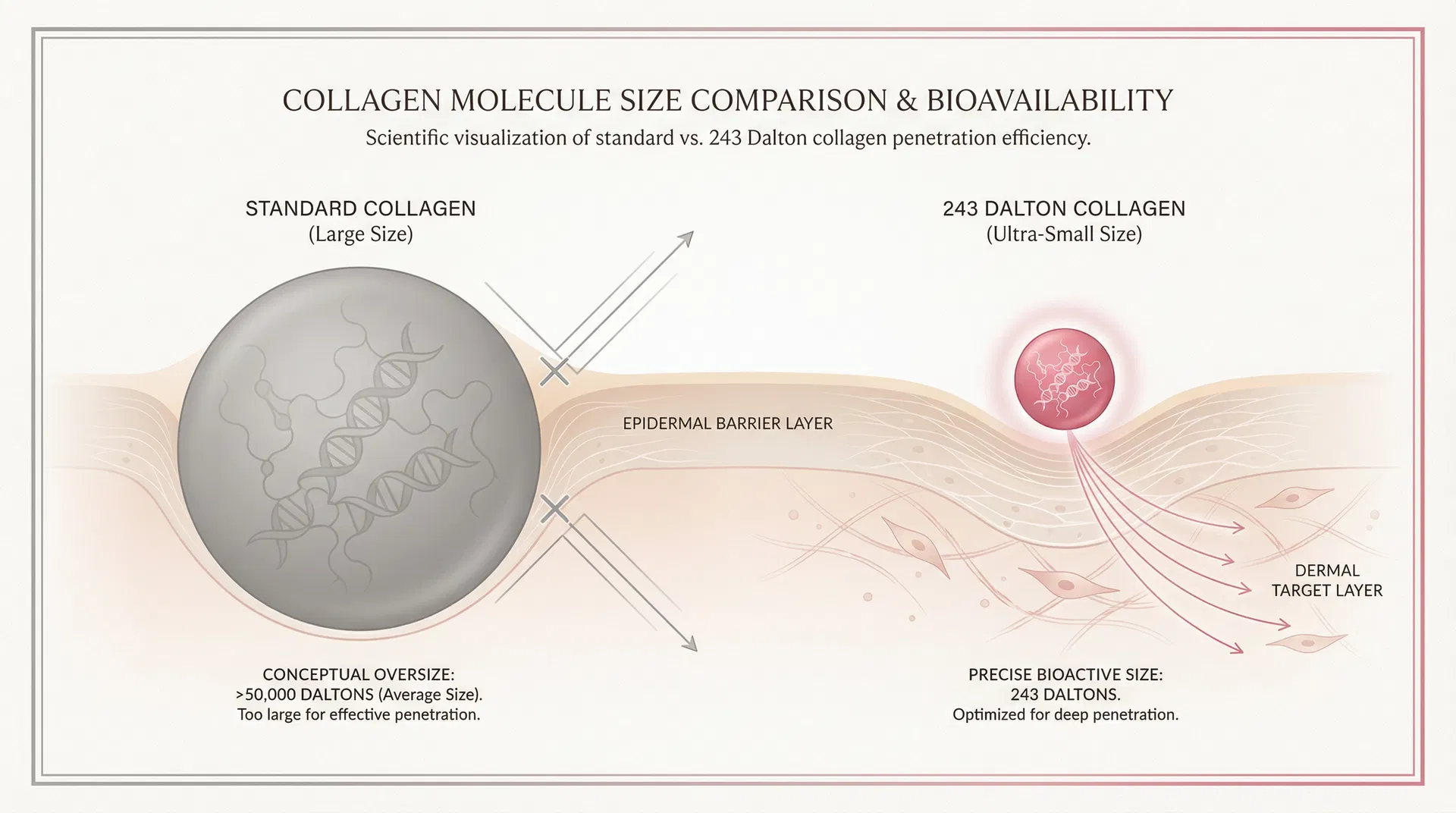
Topical collagen was theorized to address this by supplementing what the body loses. The problem — and this is the problem that every working dermatologist knows about — is that standard collagen molecules are too large to cross the epidermal barrier and reach the dermis where they could actually do something.
The Science, Simply
Your skin has a natural barrier that only lets very small molecules through — anything under about 500 Daltons. Standard collagen in most creams? It's 300,000 to 3,000,000 Daltons — thousands of times too large. Those molecules just sit on the surface, making your skin feel temporarily smoother without actually reaching the deeper layers where collagen loss happens.
Standard collagen molecules are too large to penetrate the epidermal barrier. 243-Dalton collagen passes through to the dermis.
This is not a fringe position. It is consensus biochemistry. It is why I stopped recommending collagen creams in 2011.
What I had never seen — what the Western beauty industry had not produced, as far as I was aware — was a formulation that had actually solved this problem. That had taken collagen and reduced its molecular weight to something the skin could absorb.
Until the brief my colleague sent me described exactly that.
"Every dermatologist knows collagen molecules are too large to penetrate. The question we stopped asking was: what if someone made them small enough?"
— Dr. Diane Vasquez
243
Daltons
The molecular weight needed to actually penetrate the skin barrier and reach the dermis. Standard collagen is 300,000+ Daltons — over 1,200x too large.
The Breakthrough
Low Molecular Weight Hydrolysis: The Process That Changes the Equation
Korean cosmetic biochemistry has been working on this delivery problem for fifteen years. The approach — Low Molecular Weight Hydrolysis — involves breaking collagen protein chains into peptide fragments small enough to cross the epidermal barrier. The target molecular weight is sub-500 Daltons, ideally around 243 Daltons, which represents collagen peptides compressed to a size genuinely capable of dermal penetration.
At 243 Daltons, these peptides do not sit on the skin's surface. They cross the epidermis. They reach the fibroblast cells in the dermis — the cells responsible for producing collagen — and signal upregulated collagen synthesis. This is a meaningfully different mechanism from surface hydration. You are not masking the structural deficit. You are telling the skin to address it.
Inside a Korean cosmetic biochemistry lab: engineering collagen molecules small enough to cross the epidermal barrier.
The second innovation is delivery format. Diluting these peptides into a cream or serum introduces emulsifiers, preservatives, and water that reduce concentration and limit contact time. The research brief described a dissolving film format — a thin membrane applied directly to skin that maintains sustained, undiluted, direct-contact collagen delivery for four or more hours as it slowly absorbs.
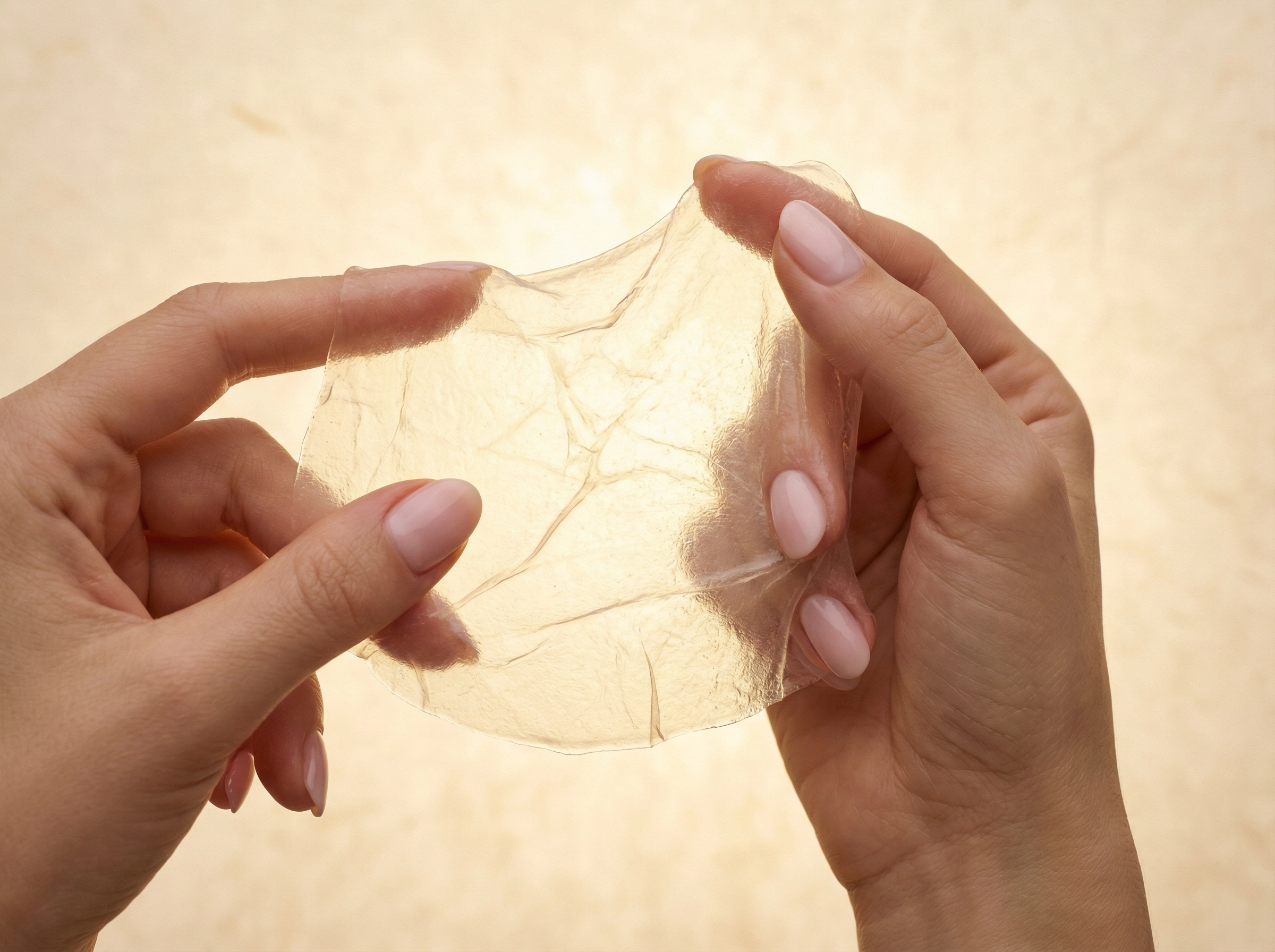
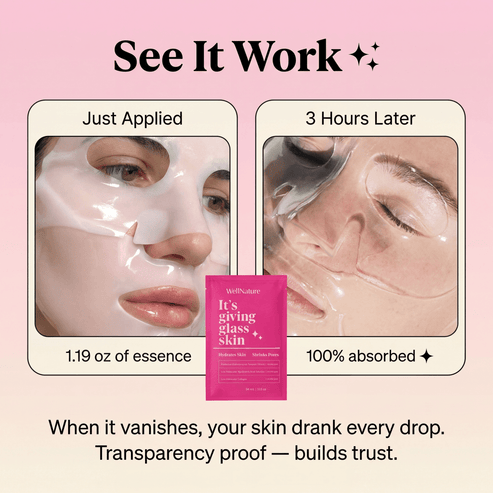
The visual indicator is the proof mechanism: the film transitions from opaque white to translucent as it's drawn into the skin. If it has absorbed correctly overnight, there is nothing left on the surface by morning.
The dissolving collagen film — transitions from opaque white to translucent as it absorbs into the dermis.
Why This Is Different
The combination of ultra-small collagen molecules with a dissolving film that stays on your skin for hours is genuinely different from anything else out there. It addresses the two biggest problems with regular collagen creams: the molecules are small enough to actually absorb, and the film format keeps them in contact with your skin long enough to make a real difference.
When I finished reading the brief, I did something I rarely do: I went looking for the product.
The Search
Why This Formulation Didn't Exist in the U.S. — And What I Found When I Looked
I spent the better part of two months trying to find a U.S. brand using this technology at therapeutic concentrations. Most of what I found used the phrase "low molecular collagen" as marketing language without specifying molecular weight. Several products listed collagen hydrolysate in their ingredient panel at concentrations too low to matter. A few Korean brands were doing it properly, but distribution in the U.S. was limited and inconsistent.
The honest explanation for the gap is commercial. True sub-500 Dalton hydrolysis requires specialized equipment and significant quality control investment. It's more expensive to produce, harder to standardize, and yields a product that can't be easily marketed with aspirational claims because the mechanism requires explaining. The beauty industry prefers simple stories.
The transparency proof: the film transitions from opaque to fully absorbed overnight.
WellNature was the brand I found that had actually done this correctly.
They had sourced low molecular collagen at 243 Daltons from Korean cosmetic laboratories and paired it with Galactomyces Ferment Filtrate — a brightening compound with strong evidence behind it — and a Hyaluronic Complex for dermal hydration. The film format matched the delivery mechanism described in the research. The molecular weight was specified, not implied.
I ordered the product to evaluate it clinically. Then I used it myself. Then I started recommending it to patients who fit the profile — women in their late thirties to early fifties, experiencing collagen-loss signs, frustrated with topical routines that weren't delivering results.
I've been doing that for eight months now.
My Recommendation
What I'm Now Recommending — and Why
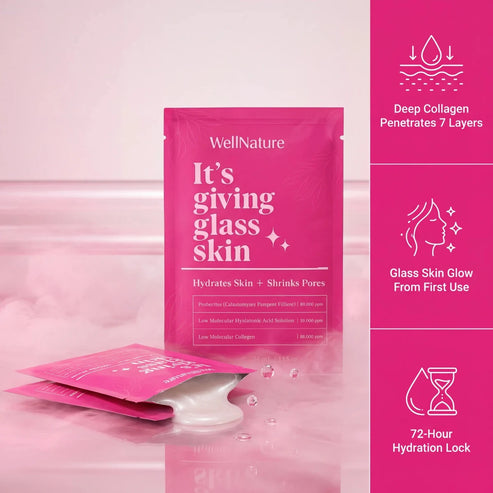
The product is the WellNature Deep Collagen Overnight Mask. It is a dissolving collagen film, not a sheet mask or sleeping pack. Each mask contains low molecular collagen at 243 Daltons, Galactomyces Ferment Filtrate, and a Hyaluronic Complex.
Application: apply to clean skin after your evening routine. Wear for a minimum of four hours — overnight is optimal. The film will transition from white to translucent as it absorbs. By morning, in the vast majority of cases, the film has been fully taken up by the skin.
What I tell patients about what to expect: in the first week, most notice improved morning texture and hydration that lasts into the afternoon. By weeks three and four, patients who use it three to four nights per week typically report visible changes in firmness and tone that they haven't attributed to anything else in their routine — because they haven't changed anything else.
What I'm Recommending
WellNature Deep Collagen Overnight Mask
Dissolving collagen film with 243-Dalton low molecular collagen, Galactomyces Ferment Filtrate, and Hyaluronic Complex. Apply at night. Wake up to visibly different skin.
The price point is $7 per treatment. For patients who have been spending $150–$200 on night creams that cannot penetrate the dermis, this represents both a more effective and a significantly more economical intervention.
Apply it. Sleep in it. Let your skin do the rest.
"This isn't me endorsing a beauty trend. This is me finally finding something I can honestly say works — and feeling good about sharing it."
— Dr. Diane Vasquez, MD, FAAD
Real Results
What My Clients Are Saying After 8 Months
Of the women I've recommended WellNature to since last spring, the feedback has been remarkably consistent. Here are three stories that stand out:
Sarah's Story
"I've been trying retinoids on and off for three years. My skin never tolerated them well and I never saw the results I was told to expect. After six weeks with the mask I noticed something I hadn't felt in years — my skin felt 'tight' in the good way. My husband asked me twice in one week if I'd had something done."
Age 44 · Fine lines and dullness · Frustrated with retinoids
The moment patients describe: recognizing their own face again.
Rachel's Story
"I was skeptical because I've been skeptical of everything. Dr. Vasquez said the science was different this time. She was right. I use it four nights a week. My skin looks like it did three years ago. I'm not saying that lightly."
Age 39 · Noticing early changes · Wanted something that actually works
Linda's Story
"I stopped expecting things to work about five years ago. This worked. I don't know what else to say."
Age 51 · Dullness and loss of firmness · Had given up on products
Morning after the mask. The results patients keep describing.
As for my own skin: I'm 46. I started using the mask in October. My aesthetician asked me at my last facial in January what I had changed. I told her. She ordered it that evening.
A note on transparency: I want to be clear about one thing: I am recommending this because the mechanism is sound and I have watched it work in my patients over eight months of observation. I am not a brand ambassador. I have no financial relationship with WellNature. I am telling you this because it is the honest answer to the question I am asked most often in clinical practice: "Is there anything that actually works?"
For this specific mechanism, at this specific molecular weight, delivered in this format — yes. Finally.
⚠️ Update — March 2025
Since this article was published, WellNature has seen a significant demand increase and is shipping from limited stock. If you're considering trying it, current inventory and bundle pricing are still available online — but availability has been inconsistent due to production constraints on the collagen hydrolysis process.