

melanin
Laser Wasn't Built For Your Melanin. This Was.


You know the routine.
You shave. By evening, there's stubble. But worse than the stubble — there are bumps. Ingrowns. Those dark marks that take months to fade. You buy a dark spot corrector to fix the damage caused by hair removal that was supposed to make you feel better.
You try waxing. It lasts longer, but the pain is real — and the hyperpigmentation follows. You look into laser. And that's when you discover something nobody told you upfront:
Laser hair removal targets melanin.
Your skin is melanin.

The laser can't tell the difference between the melanin in your hair and the melanin in your skin. The result? Burns. Hyperpigmentation. Scarring. The clinics that are actually safe for darker skin charge $6,000+ — and they're not in every city.
So you keep shaving. You learn to live with the bumps. You spend more fixing what shaving did to your skin than you ever spent on the razor itself.
The entire hair removal industry was built for one skin type.
Everyone else was expected to adapt.

You've done the research. You've watched the YouTube videos. You've read the Reddit threads. You've asked your friends. And the answer is always the same: "Laser doesn't really work for our skin."
Razors leave bumps. Waxing leaves dark marks. Laser leaves burns. Creams leave chemical irritation. Every method starts after the hair has already grown — and every method damages melanin-rich skin in the process.
The cycle: remove → inflame → scar → wait → remove again.
"The entire category asks you to choose between smooth skin and healthy skin. As if you can't have both. As if your melanin is the problem."

But what if the problem was never your hair?
What if the problem was never your melanin?
What if the problem was the method?
What if — instead of removing hair better — you could just… grow less of it?
There's a compound that does exactly that.
It doesn't interact with melanin. At all.
Note: This article examines a botanical compound with a published PubMed clinical study showing comparable efficacy to Alexandrite laser — that works regardless of skin tone. No melanin interaction. No burns. No bumps. Your ancestors already knew about it.

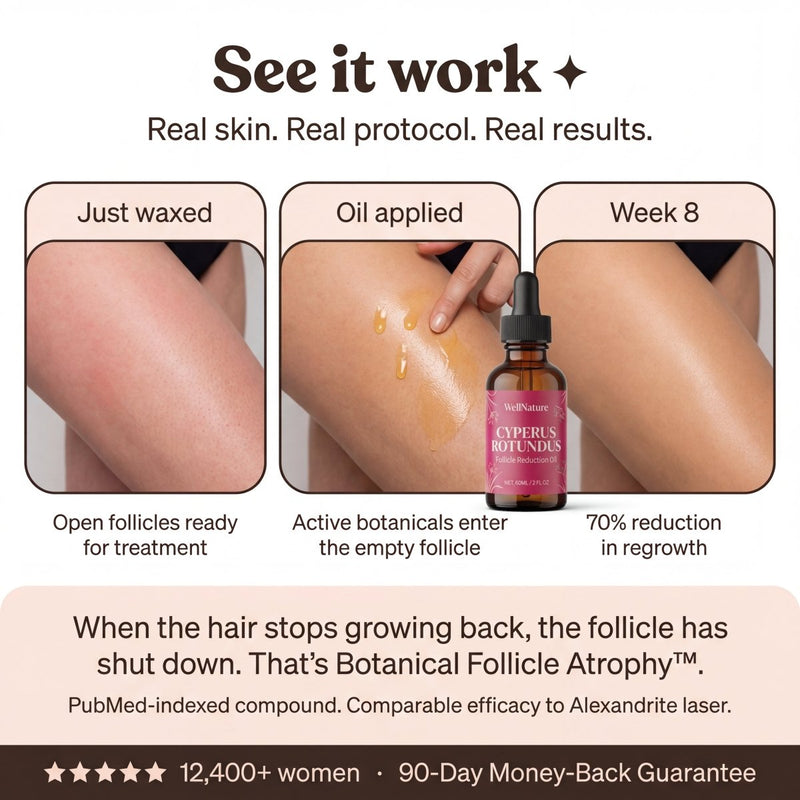
Every hair removal method starts after the hair has already grown. Shaving cuts it. Waxing pulls it. Laser burns it. They're all reactive — dealing with the symptom, not the cause.
WellNature's Cyperus Rotundus oil works differently. It slows the regrowth cycle at the follicle level — so there's progressively less hair to deal with. Over 6–8 weeks, hair comes back finer, slower, and eventually some follicles stop producing visible hair altogether.
And critically: it doesn't interact with melanin at all. Unlike laser, which targets melanin (and can't distinguish your hair from your skin), Cyperus Rotundus works through a completely different pathway. It influences the growth cycle of the follicle itself.

Cyperus Rotundus — known as nutgrass — has been used across Africa, India, and the Middle East for centuries in traditional medicine. Long before clinical trials, women in these regions understood the plant's effect on hair growth.
WellNature bridges traditional botanical knowledge and modern clinical validation. This isn't a lab invention — it's a rediscovery. Ancient root. Published science. Your follicles respond to the compound, not to marketing.
For the first time, a hair reduction product wasn't designed for lighter skin and then adapted. It was designed to work regardless of skin tone from the start.

This isn't marketing copy. Cyperus Rotundus has been studied in peer-reviewed clinical research published on PubMed. Results showed comparable efficacy to Alexandrite laser for reducing hair regrowth.
The critical difference: laser achieves this by targeting melanin. Cyperus Rotundus achieves this by influencing the hair growth cycle at the follicle level. No melanin interaction means no burns, no hyperpigmentation, no skin tone restrictions.
Third-party tested. Botanically certified. Cold-pressed to preserve active compounds. Not a "proprietary blend" — a single, studied ingredient doing exactly what the research says it does.

Women with coarser, curlier hair are significantly more prone to ingrown hairs, razor bumps, and post-inflammatory hyperpigmentation from shaving. The hair curls back into the skin. The follicle inflames. The inflammation triggers dark marks.
The razor bump cream industry only exists because razors damage melanin-rich skin. We'd rather solve the first problem.
As hair reduces, you shave less. Fewer shaves means fewer ingrowns, fewer bumps, fewer dark marks. The solution reduces the damage by reducing the need for the thing that causes it.
"Your melanin isn't the problem. The method is."
— Skin-Journal Editorial Team
What To Expect

After your normal hair removal (whatever that is — shaving, waxing, sugaring), apply the oil to the treated area. The follicles are open. The active compounds enter directly.
That's the entire protocol. No appointments. No specialist clinic. No geographic barrier. No sitting in a waiting room wondering if the equipment is calibrated for your skin tone.
One bottle. Your bathroom. 30 seconds. Results in 6–8 weeks.

"Safe" laser for darker skin tones means specialist clinics, higher prices, longer drives. You're paying a premium for equipment that should have been standard.
Razors + shaving cream + bump treatment + dark spot corrector + waxing appointments = a recurring cost that never ends. WellNature replaces most of that shelf.
| Method | Cost | Safe for melanin? | Cyperus Root |
|---|---|---|---|
| Razors (yearly) | $300+ | Bumps & dark marks | No bumps |
| Waxing (yearly) | $1,200+ | Hyperpigmentation risk | No inflammation |
| Standard laser | $2,000+ | Burns on darker skin | No melanin interaction |
| Specialist laser | $6,000+ | Safer but expensive | $59 per bottle |
| WellNature | $59 | All skin tones | PubMed-backed |
PCOS affects 1 in 10 women and causes excess hair growth driven by hormonal imbalance. Most removal methods don't address this — they just cut or pull hair that hormones keep producing.
Cyperus Rotundus works at the follicle level regardless of what's driving the growth. Hormonal hair, coarse hair, fine hair — the compound doesn't discriminate. It influences the growth cycle directly.
For women with both PCOS and darker skin, the combination of hormonal hair growth + melanin-reactive removal methods is particularly frustrating. This addresses both problems simultaneously.

What you put ON your skin ends up IN your body. WellNature is cold-pressed to preserve active compounds. No synthetic hormones. No endocrine disruptors. No "proprietary blends" hiding cheap fillers.
Pure Cyperus Rotundus extract. Jojoba + Sweet Almond carrier. Lavender + Tea Tree + Ginger Root. That's it. A single, studied ingredient doing exactly what the research says it does. Your follicles respond to the compound, not to marketing.


90-day money-back guarantee. Use the entire bottle. If you don't see results, you get a full refund. No questions. No fine print.
We can offer this because the clinical data supports it. 92% of women stopped buying razors. 89% would recommend to a friend. 4.8 average rating across 12,400+ reviews.
You've already spent thousands on methods that weren't designed for your skin. This one was. And if it doesn't work, it costs you nothing.

Editor's Note: This article was originally published in our March issue. Due to overwhelming reader response — particularly from women who said they'd never seen a hair reduction product acknowledge the melanin gap — we've updated it with additional clinical data and reader testimonials. WellNature is currently running a 52% off promotion with free shipping. Check availability here.
"The most powerful thing you can say to an underserved audience isn't 'we're for everyone.' It's 'we thought about you specifically.'"
— Skin-Journal Editorial Team