

tiktok
I Spent 11 Years Tweezing My Chin Every Morning. Then a Dermatology Study Changed Everything.
If you’ve got hairs on your chin, your upper lip, or your jawline — you already know.
You tweeze in the morning. You check the rearview mirror at every red light. You carry tweezers in your purse like they’re your house keys.
I did this every single day for over a decade.
Waxing? Hurt like crazy. Hair came back in a week. Depilatory creams? Burned my skin and the hair still came back. I looked into laser — $3,000 minimum, six sessions, and my friend said hers grew back after two years.
I was starting to accept this was just my life.
Then I learned something that changed how I think about all of it. And it had nothing to do with finding a “better” way to remove hair.
Here’s what nobody told me — and what I wish I’d understood years ago:
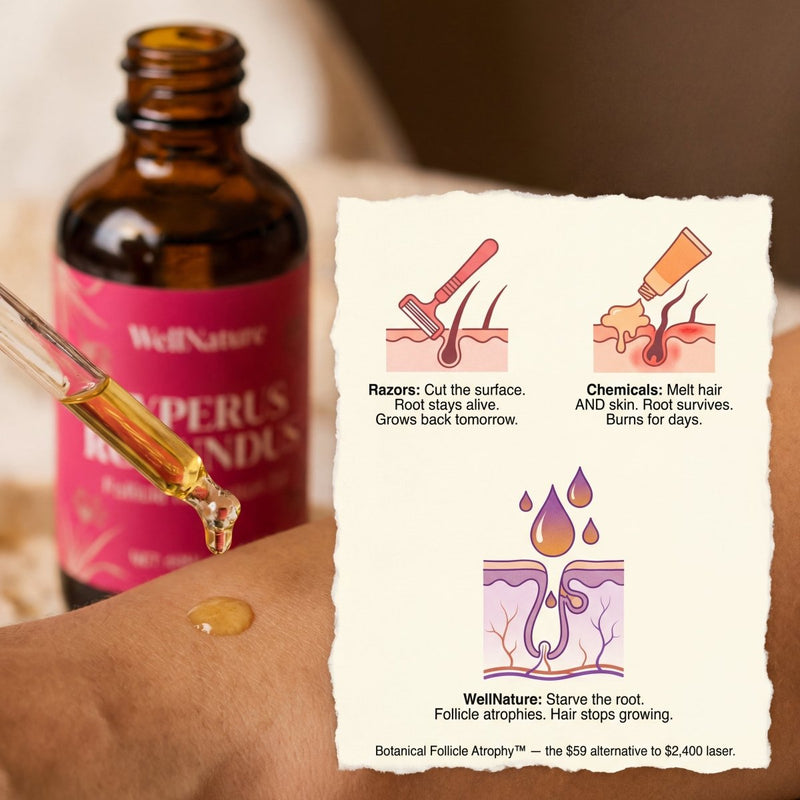
Every method I’d ever tried was doing the same thing. Removing the hair. Cutting it. Pulling it. Melting it. Burning it.
But none of them touched the actual reason the hair keeps coming back.
Your follicle has a blood supply. That blood supply feeds the root. As long as that blood supply is active, your body will keep growing hair — no matter how many times you remove it.
Think about it. A razor cuts the hair at the surface. The root is untouched. Hair’s back by tomorrow.
Waxing rips the hair out. But the root is still alive, still fed. It grows right back in a few weeks.
Even laser — which sounds like it should be permanent — works by burning the follicle. But here’s the thing: your body is designed to heal burns. That’s literally what bodies do. So the follicle heals. And the hair comes back. Usually within one to three years.
That’s why laser clinics sell “touch-up packages.” They already know it’s coming back.
“I did laser at 34. Full legs and bikini. $4,000. It worked for about 3 years then everything grew back. Every single hair. I felt so stupid for spending that money.”
So the question isn’t “what’s the best way to remove hair?”
The question is: how do you stop the follicle from producing it in the first place?
I started seeing this oil all over TikTok. First it was Nina Poole. She was talking about how it’s just as effective as laser hair removal. I thought, yeah, sure.
Then another woman popped up on my feed. Then another. They were all talking about the same thing: an oil made from a root called Cyperus Rotundus — also known as nutgrass.
Everybody and their mama wanted the receipts. So did I. I’m not the type to trust a TikTok video. I went looking for the actual science.
And I found it.
“Topical Cyperus rotundus Oil: A New Therapeutic Modality With Comparable Efficacy to Alexandrite Laser Photo-Epilation”
Researcher: Dr. Ghada Mohammed, MD — Department of Dermatology, Suez Canal University, Egypt
Design: Randomized controlled trial. 65 women with unwanted hair. Three groups: Cyperus oil vs. Alexandrite laser (GentleLase by Candela) vs. saline placebo.
Assessment: Hair counts, independent professional observation, and patient self-assessment — all three methods.
“Overall results did not differ significantly between C. rotundus oil and the Alexandrite laser.” (P > .05)
Translation: In a head-to-head clinical trial, this oil matched the results of a $3,000+ laser procedure. And it actually outperformed laser on white and light-colored hair (P < .05) — hair that laser physically cannot treat.
Side effects detected: None.
That’s not a blog post. That’s not an influencer’s opinion. That’s a peer-reviewed study in a surgical journal, published by Oxford University Press.
When I read that, I stopped scrolling and started paying attention.
“I’m skeptical by nature. 20 years in healthcare will do that. But my daughter showed me the PubMed study and I thought okay, the data actually looks reasonable. Tried it on my upper lip and chin. Week 7 and there’s a real visible difference. I’ve recommended it to three patients already.”
So how does it actually work? And why is it different from everything else?
The study found that Cyperus Rotundus oil contains flavonoids with antiandrogenic activity. In plain English: natural plant compounds that block the hormones feeding your hair follicle.
Here’s the process:
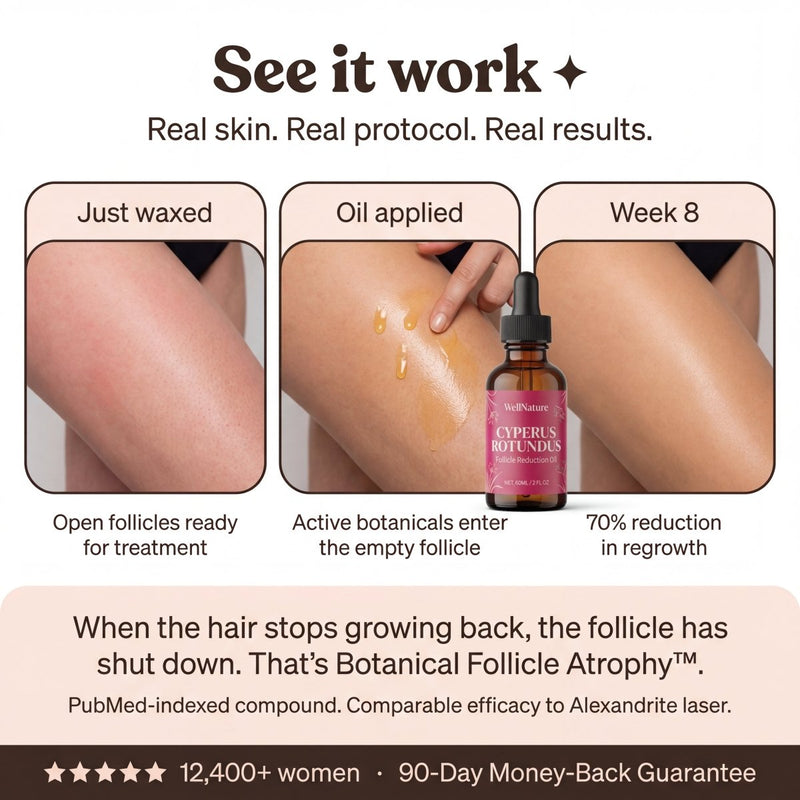
This is fundamentally different from every other approach. You’re not fighting your body. You’re not burning tissue and hoping it doesn’t heal. You’re cutting off the supply line at the source.
Here’s what each method actually does to the follicle’s blood supply:
Only one of those methods addresses the actual root cause. The rest are treating symptoms.
“I went to my dermatologist for a routine thing at week 8 and she literally looked at my jaw and said ‘what have you been doing differently.’ I showed her the bottle. She photographed it. I don’t know what she’s doing with that information but I like to think she’s recommending it to everyone.”
What’s actually in it?
The active ingredient is cold-pressed Cyperus Rotundus root oil. That’s the nutgrass root — the same plant Egyptian women have used for centuries. The 2025 Wiley review paper confirmed that its key compound, γ-curcumene, suppresses hair growth at the follicular level.
The carrier oils (jojoba and sweet almond) help it absorb into the skin without clogging pores. Lavender and tea tree calm post-wax redness and prevent ingrowns. No synthetic hormones. No chemicals.
What’s Inside

The 2014 study noted “no side effects were detected” across all participants. A separate 2022 study (also PubMed-indexed) found that Cyperus Rotundus oil is gentle enough to actually treat the side effects of laser hair removal — the redness and pain that laser causes.
So this isn’t just safe. It’s literally used to soothe skin that other methods have damaged.
Clinically Documented Safety
“No side effects were detected” — Aesthetic Surgery Journal, 2014. Safe for face, bikini line, underarms, and everywhere else. Calms irritation instead of causing it.
Here’s what happened when I actually tried it.
I ordered two bottles because I wanted to do my chin and my upper lip at the same time. It showed up in two days.
After I tweezed, I put a few drops on. It smelled earthy and herbal. Absorbed fast. No residue. No burning. Nothing.
Week 1: Skin felt softer. The irritation from tweezing was basically gone. I thought, okay, at least it’s soothing.
Week 3: This is where I noticed something real. The hair that grew back was thinner. Noticeably. I went from tweezing every day to maybe twice a week. The study said the flavonoids suppress the blood supply each cycle — and I could see it happening.
Week 6: I haven’t had to reapply for weeks. One random hair popped up and it made me mad — because they used to come every other day. Now? Not so much.
I can take my tweezers and throw them out.
“I’ve been plucking my chin every morning since I was 16. I’m 27 now. That’s 11 years of waking up early to sit in front of a mirror with tweezers. Week 8 and I’m down to maybe 4–5 hairs. I used to pluck 25+. The dark patch under my chin is lighter too. I don’t wanna be dramatic but I got a little emotional about it.”
“Nobody warns you that perimenopause comes with chin hair. Like actual thick dark hairs that show up overnight. I was tweezing every morning before the school run hoping the other moms couldn’t see. 8 weeks on this and I tweeze maybe twice a week now. The hairs that do come back are so much finer.”
Let me put the cost in perspective.
I was spending $80 a month on threading. My friend spent $4,000 on laser and it grew back. Another friend does $60/month waxing appointments indefinitely.
This oil is $29.95 a bottle. One bottle lasts about a month. Most women see dramatic results within 6–10 weeks.
The clinical trial used the Alexandrite laser — the same laser that costs $3,000–$6,000 for a full course. The study found no significant difference in results between the oil and the laser.
Read that again. Same results. Two percent of the cost. At home. In two minutes.
“10 weeks later and my legs are smoother than they were after the laser. For $59. I can’t even talk about it without getting annoyed at how much I wasted.”
“I’m 43 and I’ve been dealing with chin hair since my late 30s. I was spending $80 every 4 weeks on threading and it was STILL growing back thicker. My aesthetician actually told me about this oil. 6 weeks in and the regrowth is noticeably finer. Should’ve tried this years ago.”
This works on chin hair, upper lip, jawline, sideburns, bikini line, underarms, legs — anywhere you’ve got unwanted hair. The study tested it on axillary hair. The reviews confirm it works everywhere.
Sensitive skin? The study found zero side effects. The natural compounds calm irritation instead of causing it. Red bumps and ingrowns? Ten out of ten recommend this.
If you deal with PCOS, hormonal hair, perimenopause hair, or just stubborn hair that won’t quit — the mechanism is the same. The flavonoids suppress the blood supply regardless of why the hair is growing.
“I have this one hair on the left side of my chin that grows back literally overnight. I named it Harold. Harold is GONE. Like the follicle has given up. Week 8 and the spot where Harold lived is just flat smooth skin. I keep touching it out of habit.”
Look. I’m not a doctor. I’m not a dermatologist. I’m just a woman who was really tired of tweezing her chin every morning before work.
But the science is real. The study is published. The mechanism makes sense. And 12,450 women have left reviews saying it worked for them.
Right now it’s 50% off with free shipping. They’ve sold out five times already. I don’t know how long the current stock will last.
If you’ve been dealing with unwanted hair — especially if you’ve already tried everything else — this is the one thing that addresses the root cause. Not the symptom. The cause.
Grab one or two bottles. You’ve got 90 days to decide if it works. I’ll link it for you below.
★★★★★ 12,450+ reviews
Cyperus Root Elixir
Your skin deserves better than tweezers and razor burn.